Key Takeaways
Who fixes water damage in Chula Vista usually depends on the cause: restoration professionals handle extraction, drying, and documentation, while a licensed plumber (or other trade) stops the leak and completes code-required repairs. Prompt, measured drying matters because moisture can migrate behind walls and under flooring, affecting materials and increasing the risk of odors or microbial growth.
- Two-part response (stop water + dry the structure): A qualified team first stabilizes the loss by stopping the source and then uses extraction, dehumidification, monitoring, and verification drying so repairs don’t begin while materials are still wet.
- Inspection should be measurement-based: A professional on-site inspection combines visual assessment with moisture mapping (meter readings, non-invasive scanning, and sometimes targeted openings) to determine what got wet, how far moisture traveled, and what must be removed versus dried in place.
- Documentation and scope protect the claim and the rebuild: Credible providers supply a written scope plus photos, moisture readings, and drying logs, while recognizing that coverage depends on the policy and source of water and that restoration teams generally can’t determine coverage.
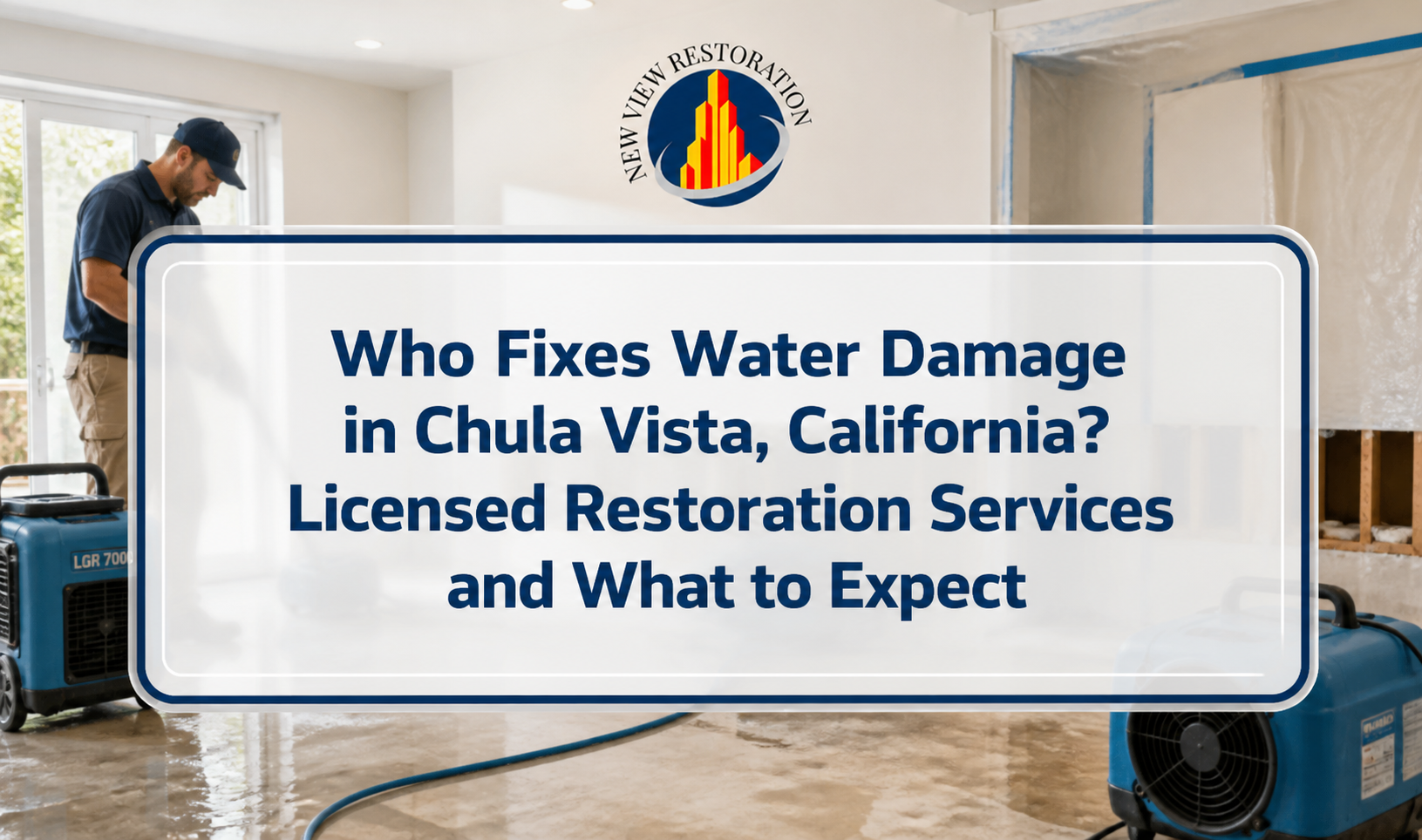
Licensed water damage restoration professionals and qualified plumbers typically handle water damage cleanup and repairs, and they are the ones most residents call when searching who fixes water damage in Chula Vista. The right provider will assess the source and category of water, stop the intrusion, extract standing water, dry structural materials, and document conditions to support any insurance claim.
Prompt response matters because moisture can migrate behind walls and under flooring, increasing the risk of material deterioration and microbial growth. In practice, restoration work may involve moisture mapping, controlled demolition of saturated materials, use of commercial dehumidifiers and air movers, and verification drying with moisture meters before rebuild steps begin.
This guide explains which licenses and certifications to look for, what a typical on-site inspection includes, how estimates and insurance coordination usually work, and what timelines to expect from emergency mitigation through repairs in a Chula Vista home or business.
Who fixes water damage in Chula Vista (and when you need more than one pro)
In most cases, who fixes water damage in Chula Vista depends on what caused the loss: a restoration contractor handles drying and cleanup, while a licensed plumber (or other trade) stops the leak and completes code-required repairs.
Water damage is often a “two-part” problem: first, stop the water source; second, remove moisture from the structure before it spreads. A qualified team will coordinate mitigation, documentation, and (when needed) rebuild work so you don’t dry the wrong areas or miss hidden moisture that can lead to odors, staining, swelling, or microbial growth.
- Water damage restoration professionals focus on extraction, structural drying, dehumidification, demolition of unsalvageable materials, cleaning, and monitoring.
- Plumbers address supply/Drain/Waste/Vent failures, fixture leaks, water heaters, slab leaks, and related repairs to stop active intrusions.
- Specialty trades (roofing, window installers, HVAC, flooring, electrical) may be necessary when the source is outside plumbing or when materials need repair/replacement.
How to choose a qualified water damage contractor or plumber
Look for providers who can prove they are properly licensed/insured for the work they’re doing, use professional drying equipment, and can clearly explain their plan, measurements, and documentation.
Because water damage can quickly become a hidden moisture problem, you want a company that does more than “shop-vac and fans.” Ask what they will measure, how they will contain the work area (if needed), and how they will verify drying before closing materials back up.
Credentials and documentation to ask for
Good providers should be comfortable sharing basic proof of qualifications, scope, and job notes—especially if an insurance claim is involved.
- License fit: plumbing work should be performed by a licensed plumber; restoration work should be handled by a qualified restoration contractor following recognized industry practices.
- Insurance: ask for proof of general liability and (if applicable) workers’ compensation coverage.
- Training/certifications: many restoration teams carry industry training in water restoration and drying science; ask what standards they follow and how they document moisture readings.
- Written scope: a clear outline of affected rooms/materials, equipment plan, monitoring schedule, and what’s excluded.
Red flags that can cost you time and money
Water damage work is time-sensitive; vague scopes and poor measurement practices can lead to incomplete drying or unnecessary tear-out.
- They won’t identify the likely source, category, or affected materials—even at a high level.
- They propose painting or replacing flooring before moisture verification drying.
- They won’t provide moisture readings, photos, or drying logs (especially for insurance).
- They rely on a single household dehumidifier/fans for a significant loss.
- They recommend closing walls/ceilings without discussing hidden moisture pathways.
What a professional on-site inspection should include
A proper inspection combines visual assessment with moisture measurement so the drying plan targets the full extent of wet materials—especially in walls, ceilings, and flooring systems.
Many problems in Chula Vista homes come from supply line leaks, water heater failures, shower pan issues, appliance hoses, or wind-driven rain at windows/doors. The goal is to determine what got wet, how far moisture traveled, and what must be removed versus dried in place.
Moisture mapping and measurement
Moisture mapping is the process of tracing wet areas using meters and (when useful) thermal imaging to guide extraction, drying, and selective demolition.
- Moisture meter checks: technicians compare readings in affected vs. unaffected materials to find elevated moisture.
- Non-invasive scanning: helps locate suspect areas behind baseboards, under flooring, and around wet walls/ceilings.
- Targeted openings: small test cuts may be recommended to confirm conditions inside wall cavities.
- Pre-existing conditions: staining, old leaks, or prior repairs should be noted so new damage is clearly documented.
Water category considerations (clean vs. contaminated)
The category of water helps determine how aggressive cleaning and removal needs to be, because contamination changes safety and salvageability decisions.
For example, a supply line leak in a kitchen wall is different from a sewer backup. If there’s uncertainty—such as water from a drain line overflow—pros may treat it more conservatively until the source is verified.
If you want background context on how water damage develops and what it can affect, see water damage.
Typical water damage cleanup process (from emergency to dry standard)
Most professional jobs follow a predictable sequence: stop the water, remove standing water, dry and dehumidify materials, monitor progress, and only then begin repairs.
This sequence matters because drying isn’t just about “airing things out.” It’s controlled evaporation and moisture removal—done with the right equipment placement, temperature/humidity management, and verification.
- Emergency stabilization: shut off water, address active leaks, and protect contents with basic measures (moving items, blocking off hazards).
- Extraction: remove standing water using commercial pumps/extractors; faster extraction reduces secondary damage.
- Removal of unsalvageable materials: saturated drywall, insulation, pad, or swollen materials may require controlled demolition.
- Drying setup: air movers and dehumidifiers are staged to dry structural materials, not just the air.
- Monitoring: regular moisture readings and equipment adjustments based on drying progress.
- Cleaning and deodorization (when needed): especially after gray/black water events or when odors develop.
- Verification drying: confirm materials meet an appropriate dry standard before reconstruction begins.
If you’re looking for a service that covers these steps end-to-end, water damage cleanup is commonly the starting point for mitigation, documentation, and drying.
Timelines you can realistically expect in Chula Vista
Drying and repairs don’t happen instantly; most delays come from hidden moisture, approvals (especially insurance), and trade scheduling for rebuild work.
While every loss is different, the drying phase often takes multiple days with daily or near-daily checks. Materials like dense hardwood, layered assemblies, and insulated exterior walls may require longer monitoring and careful equipment placement.
| Phase | What typically happens | What can affect timing in a local home/business |
|---|---|---|
| Emergency response (same day) | Stop the source, extract standing water, protect contents, begin moisture mapping | After-hours access, multi-unit coordination (HOA/landlord), and locating shutoffs |
| Drying & dehumidification (multiple days) | Equipment placement, controlled drying, daily monitoring, selective demolition if needed | Hidden wet insulation, hardwood/underlayment saturation, and limited airflow behind built-ins |
| Cleaning & odor control (as needed) | Sanitizing surfaces, HEPA cleaning, deodorization where appropriate | Water category uncertainty, porous materials, and whether contents were impacted |
| Repair/rebuild (variable) | Drywall, paint, flooring, cabinets, trim, and any plumbing/electrical corrections | Material availability, matching finishes, permitting needs for certain scopes, and insurer approvals |
| Final documentation & closeout | Moisture verification notes, photos, equipment logs, completion paperwork | How thoroughly conditions were documented from day one and whether multiple areas were involved |
Insurance coordination: what most homeowners should prepare
Insurance claims go smoother when the provider documents the scope clearly and you keep records of cause, timeline, and affected areas—without guessing at coverage.
Coverage depends on your policy and the source of water (for example, sudden accidental discharge vs. groundwater intrusion). Restoration teams often help by providing photos, drying logs, and itemized scopes, but they generally can’t determine policy coverage.
- Document early: take photos/video of the source, affected rooms, and any visible wet materials before removal.
- Keep a timeline: when you noticed the issue, shutoff time, mitigation start time, and any changes.
- Save receipts: hotel stays, emergency supplies, and essential purchases may matter depending on coverage.
- Don’t discard key materials too early: if safe to keep, damaged parts (hose, valve, fitting) can help explain cause.
Estimate and scope basics
A credible estimate should describe what will be done and why—based on moisture findings and the materials affected—not simply a flat number.
- Rooms/areas included (and excluded)
- Planned demolition vs. drying-in-place decisions
- Equipment type and monitoring approach
- Cleaning steps (especially for gray/black water)
- Repair scope coordination (drywall, flooring, paint, trim)
Common causes of water damage in Chula Vista homes and what fixes them
Knowing the likely source helps you call the right pro first and prevent repeat losses after the structure dries.
Water can travel along framing, under tile, and through ceilings—so the visible puddle is not always the full footprint. If the source isn’t obvious, leak detection and moisture mapping can help narrow it down without unnecessary demolition.
- Supply line failures: washing machine hoses, angle stops, refrigerator lines; fix involves plumbing repair plus structural drying.
- Water heater leaks: tank failure or fittings; fix involves replacement/repair and drying of adjacent walls/flooring.
- Drain backups/overflows: tubs, toilets, kitchen drains; fix involves stoppage correction and more intensive cleaning if contaminated.
- Shower/tub leaks: failed grout isn’t always the culprit—pan liners, valves, or waterproofing can be; repair may require tile removal.
- Roof/window intrusion: often appears after rain; fixes involve exterior envelope repairs plus interior drying.
When the event is sudden and you’re deciding what to do first, it helps to review practical steps outlined in unexpected water damage in Chula Vista.
Special scenarios: sewage, flooding, and musty odors
Contaminated water and lingering odors require additional safeguards, specialized cleaning, and sometimes more material removal than clean-water losses.
If wastewater is involved, avoid DIY cleanup beyond basic safety steps. Porous materials (pad, some drywall, insulation) may not be safely restorable depending on exposure and duration, and professional protocols help reduce cross-contamination risk.
Sewer backups and contaminated water events
When a sewer line or toilet backs up, the priority is safety, contamination control, and preventing spread to other rooms.
- Limit access and keep kids/pets away from the affected area.
- Avoid running HVAC if return vents may pull contaminated air/dust.
- Don’t use household fans to “dry it out” before proper cleaning—this can spread contaminants.
- Call for professional cleanup and discuss how affected materials will be removed and disinfected.
Musty smells after drying: what it can mean
A musty odor can indicate remaining moisture, wet porous materials that weren’t removed, or microbial growth in hidden cavities.
Odors are not proof of mold, but they are a strong reason to re-check moisture levels and investigate concealed spaces. If you’re noticing lingering smells, guidance in why a home can smell musty in Chula Vista can help you decide what to check next.
Questions to ask before you hire (and how to compare answers)
The best way to choose who fixes water damage in Chula Vista is to compare how each provider measures, documents, and verifies drying—not just how fast they can arrive.
Use these questions to reveal whether the company follows a structured process and can support your claim and repairs.
- How will you determine the full affected area? Listen for “moisture mapping,” meter readings, and a plan to check cavities/adjacent rooms.
- What’s your plan to stop the source? If they aren’t a plumber, they should coordinate or advise immediate plumbing shutoff/repair.
- How do you decide what gets removed vs. dried? The answer should reference material type, swelling/delamination, contamination, and access to dry.
- How will you verify drying before repairs? Look for documented moisture readings and clear dry-standard criteria.
- What documentation will I receive? Photos, daily logs, equipment records, and a written scope are common and useful.
Getting back to normal without repeat damage
Lasting results come from solving the source, drying completely, and rebuilding with an eye toward preventing the same pathway from leaking again.
Before walls or floors are closed, ask for moisture verification and confirm the repair addresses the root cause (failed fitting, degraded seal, intrusion point, or drainage issue). If the cause was unclear, consider targeted leak detection so repairs are not based on guesswork.
- Confirm the intrusion source is repaired and tested (where applicable).
- Ask for final moisture readings in key materials before rebuild.
- Review any recommendations for upgrades (e.g., appliance hoses, drip pans, shutoff valves) that reduce future risk.
- Keep all job photos, drying logs, and invoices together for future reference or property disclosure needs.
Frequently Asked Questions
Talk to a local team before water damage spreads behind walls or floors
If you’re dealing with a leak, overflow, or water intrusion in Chula Vista, the next best step is getting a clear plan—what’s wet, what can be dried in place, and what may need removal so repairs don’t have to be repeated later. A thorough inspection and moisture measurements can help you avoid missed pockets of moisture that lead to staining, swelling, or lingering odors.
Professional help is especially useful when the source isn’t obvious, multiple rooms are involved, or you need organized photos and notes for an insurance claim. You’ll have a better path forward when mitigation and repair decisions are based on documented conditions.
Dealing with water damage now?
If it is safe, stop the water at its source, then call. We answer 24 hours a day.